Volume Of Curve Rotated About X Axis Calculator. To use the calculator, one need to enter the function itself, boundaries to calculate the volume and choose the rotation axis. You will learn to rotate a curve around the x or y axis using calculus, and calculate volume and surface area, so long as your understanding of calculus steps is up to par (as this.
Volumes of Revolution Mathematics ALevel Revision from revisionmaths.com
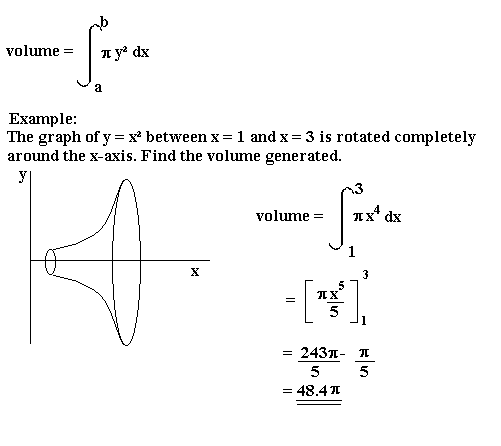
To get a solid of revolution we start out with a function, y = f (x) y = f ( x), on an interval [a,b] [ a, b]. Volume of a cylinder we can merge the formula for volume of a cylinder and our definite integral to find the volume of our solid. Since the area is rotated full circle, we can use the formula for area of a cylinder to find our volume.
To Get A Solid Of Revolution We Start Out With A Function, Y = F (X) Y = F ( X), On An Interval [A,B] [ A, B].
To use the calculator, one need to enter the function itself, boundaries to calculate the volume and choose the rotation axis. Your first 5 questions are on us! Its volume is calculated by the formula:
Since The Area Is Rotated Full Circle, We Can Use The Formula For Area Of A Cylinder To Find Our Volume.
Your volume lies between the strange outer thingy and the inner cone. But the process of visualizing this one concept has far wider applications. `v=pi int_c^d x^2dy` which means `v=pi int_c^d {f(y)}^2dy` where:
Is Being Rotated Around The Axis Under The Curve, We Can Use Disk Integration To Find The Volume.
Where area is the area in the plane of that volume, and averageheight is your goal to compute. Our online calculator, based on wolfram alpha system is able to find the volume of solid of revolution, given almost any function. In this section we will start looking at the volume of a solid of revolution.
Formulas For The Volume Of Revolution Of A Parametric Curve.
I am to find the volume of the area r bounded by the curve x = y 2 + 2, y = x − 4 and y = 0. You will learn to rotate a curve around the x or y axis using calculus, and calculate volume and surface area, so long as your understanding of calculus steps is up to par (as this. I have already found the points of intersection by first setting the lines equal to each other and used the quadratic formula:
Let Us Go Through The Explanation To Understand Better.
This is given by integrating f (x)*f (x), i.e. `x =f(y)` is the equation of the curve expressed in terms of `y` `c` and `d` are the upper and lower y limits of the area being rotated Volume = 0.0139 = area*averageheight.