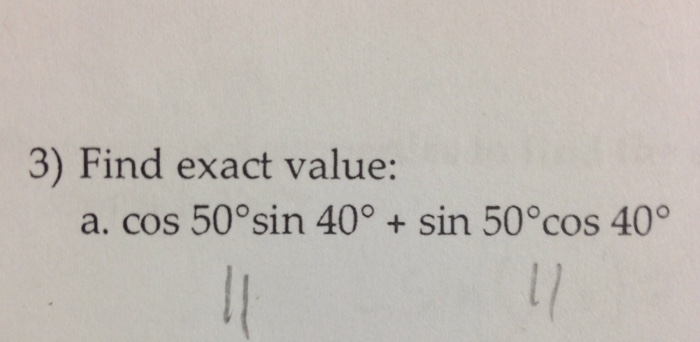
Cos 40 Degrees. Cos 20 ° cos 40 ° cos 60 ° cos 80 ° = 1/16 (proved) in easy steps. You can also represent it with the help of several other trigonometric sine functions.
Solved A. Cos 50 Degree Sin 40 Degree +sin 50 Degree Cos from www.chegg.com
\qquad \qquad \qquad \quad \quad cos70 cos40 + sin 70 sin 40 \ = \ \sqrt{3}/2. The value of cos 60 degrees can be represented in terms of different angles like 0°, 90°, 180° and 270° and also with the help of some other trigonometric sine functions. Cot 40 degrees is the value of cotangent trigonometric function for an angle equal to 40 degrees.
Value Of Cos 90° = 0.
Here, let us discuss the value for cos 90 degrees which is equal to zero and how the values are derived using the quadrants of a unit circle. For cos 30 degrees, the angle 30° lies between 0° and 90° (first quadrant ). You can also represent it with the help of several other trigonometric sine functions.
Cot 40 Degrees Is The Value Of Cotangent Trigonometric Function For An Angle Equal To 40 Degrees.
The cartesian plane is divided into four quadrants. It is the complement to the sine. For the cosine of 40 degrees we use the abbreviation cos for the trigonometric function together with the degree symbol °, and write it as cos 40°.
The Answer Is As Follows:
40 is an acute angle since it is less than 90°. Unless you know a way of evaluating this without needing to know cos (40) or sin (40) your argument is circular. The value of cos 60 takes place in the first quadrant.
1/4 Cos40+ 1/2 (Cos40 Cos100) Multiply And Divide By 2.
Cos 45° = cos π/4 = 1/√2. What is cos (40) degrees? You can represent the value of cos 60 degrees in terms of different angles like 0°, 90°, 180°, 270°.
Since The Cosine Function Is A Periodic Function, We Can Represent Cos 50° As, Cos 50 Degrees = Cos (50° + N × 360°), N ∈ Z.
If the trigonometric ratio of any angle is taken for a right angled triangle, then the values depend on sides of the triangle. This is the same answer you will get if you have a scientific calculator set to deg mode andthen enter 40 followed by the cos button. The value of cos 45° is equal to 1/√2.