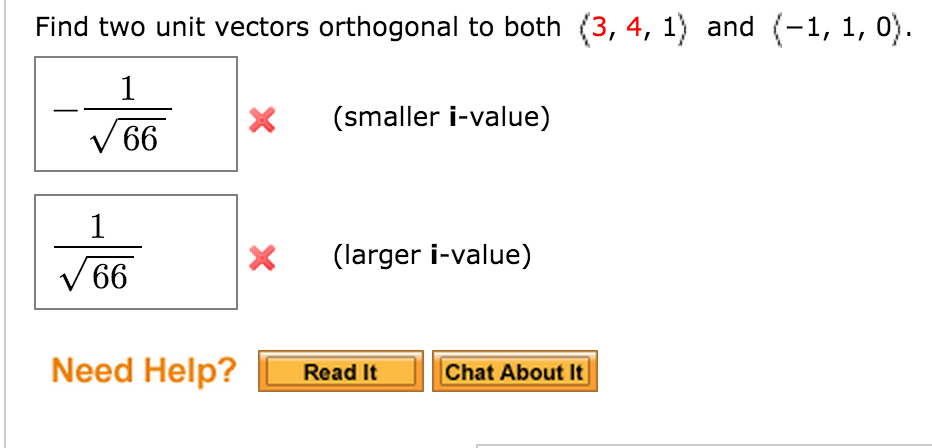
Find Unit Vector Orthogonal To Two Vectors. If playback doesn't begin shortly, try restarting your device. How do you find a unit vector that is orthogonal to both u = (1, 0, 1) v = (0, 1, 1)?
Solved Find Two Unit Vectors Orthogonal To Both (3, 4, 1 from www.chegg.com
To find a vector orthogonal to 2 other vectors, we must do a cross product. Let be the vector orthogonal to both the dot product of two vectors equals 0 if they are orthogonal. The dot product of two orthogonal vectors is 0.
Find Two Unit Vectors Orthogonal To Both J − K And I + J.
First, just find a vector that is orthogonal to the vectors (1,1,0) and (1,0,1). An orthonormal set which forms a basis is called an orthonormal basis. Let be the vector orthogonal to both the dot product of two vectors equals 0 if they are orthogonal.
There Are 3 Unknowns But Only Two Equations, Which Just Means The Solution Is Not Unique.
−3,4 = −3ˆi + 4ˆj 4,3 = 4ˆi + 3ˆj < 1, 1, 0 > ⋅ = ( 1) x + ( 1) y + ( 0) z = x + y = 0 < 1, 1, 0 > ⋅ = ( 1) x + ( 1) y + ( 0) z = x + z = 0 solve the system. A set of vectors form an orthonormal set if all vectors in the set are mutually orthogonal and all of unit length.
To Make It A Unit Vector Divide Each Component By The Length Of The Cross Product Vector, Namely By (− 1) 2 + (− 1) 2 + 1 2 = 3.
Unit vector #1 unit vector #2 page 2 1 2 @ + question: Find the cross product a × b and verify that it is orthogonal to both a and b. The cross product of 2 vectors, → a = a,b,c and → b = d,e,f is given by the determinant ∣∣ ∣ ∣ ∣ ˆi ˆj ˆk a b c d e f ∣∣ ∣ ∣ ∣ = ˆi∣∣ ∣b c e f ∣∣ ∣ −ˆj∣∣ ∣a c d f ∣∣ ∣ + ˆk∣∣ ∣a b d e∣∣ ∣
We Need To Find A Vector, #Vecc#, Such That #Veccbotveca# And #Veccbotvecb#.
Try converting the vectors to a sum of unit vectors ˆi and ˆj multiplied by coefficients: To find a vector orthogonal to 2 other vectors, we must do a cross product. This will be orthogonal to both #u# and #v#, but will need scaling to make it unit length.
The Dot Product Of Two Orthogonal Vectors Is 0.
The dot product of two orthogonal vectors is 0. In linear algebra, two vectors in an inner product space are orthonormal if they are orthogonal (or perpendicular along a line) unit vectors. The second vector the second vector orthogonal to these can be found from taking the cross product of the two vectors we now have.