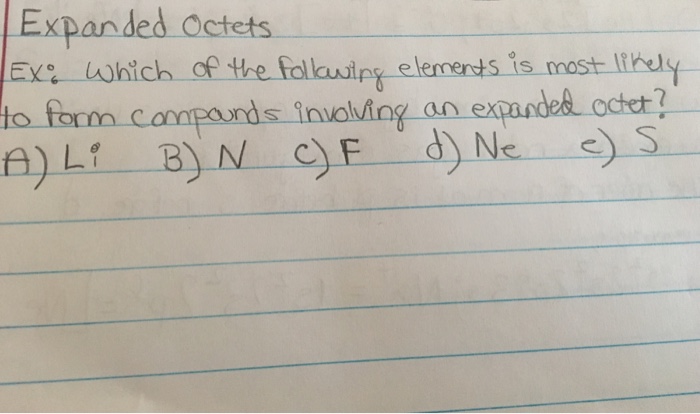
Which Elements Can Have An Expanded Octet. The third exception is elements that can accommodate more than 8 valence electrons or an expanded octet. Phosphorus pentachloride (pcl5) and sulfur hexafluoride (sf6) are examples of molecules that deviate from the octet rule by having more than 8 electrons around the central atom.
Solved Expanded Octets Ex Which Of The Following Element from www.chegg.com
Third row elements can have an expanded octet. I brought up p and s but those elements are greater than 10 and since they are in the third period, they contain 3d orbitals and extra electrons can fit around them. Which elements should never have expanded octets?
Sulfur, Phosphorus, Silicon, And Chlorine Are Common Examples Of Elements That Form An Expanded Octet.
Sulfur, phosphorus, silicon, and chlorine are common examples of elements that form an expanded octet. In the case of octet expansion, the rule is broken. The third exception is elements that can accommodate more than 8 valence electrons or an expanded octet.
I Brought Up P And S But Those Elements Are Greater Than 10 And Since They Are In The Third Period, They Contain 3D Orbitals And Extra Electrons Can Fit Around Them.
Oxygen nitrogen boron arsenic question 4 2 pts which of the following elements typically follows the octet rule он ob нf ос question 5 2 pts how many resonance structures does the nitrate anion have? Elements, such as phosphorus, sulfur, or iodine, have access to d orbitals, allowing them to accommodate more than 8 valence electrons — often up to 12 or 14. Some examples are;phosphorous pentachloride pcl5sulfur hexafluoride sf6dichloro heptoxide cl2o7
The Octet Rule Explanation In Chemistry.
What elements can expand octet? Which groups can have an expanded octet? Some examples are;phosphorous pentachloride pcl5sulfur hexafluoride sf6dichloro heptoxide cl2o7
D.(2 Points) Whi Ch Of The Following Elements Can Form Compounds With An Expanded Octet?
Which elements can have expanded octets? Question 3 2 pts which of the following elements can have an expanded octet? These elements are located in the third row of the periodic table and below.
None Of The Above T (2 Points) Which Of The Following Molecules Obey The Octet Rule:
All the other elements can have ‘depleted octets ‘ or ‘ expanded octets ‘. Sulfur, phosphorus, silicon, and chlorine are common examples of elements that form an expanded octet. Sulfur, phosphorus, silicon, and chlorine are common examples of elements that form an expanded octet.